1. Why Selecting a Clinical-Grade Nutrition API Database Is Critical in 2026
Designing clinical-grade health applications, digital therapeutics, or hospital-integrated dietary platforms requires an uncompromising standard of data precision. When software engineers and medical informatics teams evaluate a nutrition api database, they are not merely fetching macro ratios for a fitness tracker; they are deploying software that impacts patient safety, disease management, and long-term metabolic health. In an era where chronic disease management relies heavily on digital intervention, a single hallucinated ingredient or misparsed allergen profile can lead to severe adverse reactions or compromised therapeutic protocols.
Healthcare developers routinely face the daunting reality of fragmented consumer food data. Standard commercial food databases often rely on crowdsourced, unverified crowdsourcing pipelines where user errors run rampant. For a patient managing Celiac disease, severe IgE-mediated peanut allergies, or end-stage renal disease requiring strict potassium monitoring, relying on superficial string-matching algorithms is a high-risk gamble. Adhering to rigorous safety guidelines, such as those established by the Food Allergy Research & Education (FARE) Clinical Standards, requires digital systems to evaluate food products at an architectural level—parsing not just high-level labels, but deeply nested sub-ingredients and processing aids.
Furthermore, regulatory compliance across international markets complicates API integration. As global authorities tighten safety metrics—such as the European Food Safety Authority (EFSA) Additive Safety Regulations—digital health tools must maintain dynamic, real-time databases capable of identifying obscure emulsifiers, localized E-numbers, and complex chemical derivatives. A clinical-grade nutrition api database must bridge the gap between simple nutrition panels and complex biochemical safety data, ensuring that both patients and clinical teams receive actionable, bulletproof nutritional intelligence.
Building or choosing a health engine requires moving past basic calorie counters. Modern clinical applications demand structural intelligence—a system capable of evaluating compound ingredient structures, multi-person household restrictions, and deep contextual risk analysis without pushing consumers behind predatory paywalls or providing simplistic, moralizing food scores.
Scan Any Food for Nutrition Api Database in 2 Seconds Free
Never second-guess confusing grocery labels again. Download Food Scan Genius to uncover hidden additives, toxic dyes, and allergens for the whole household before you buy.


2. Deceptive Labeling, Nested Allergens, and Technical API Loopholes
Evaluating a consumer food item programmatically is notoriously difficult due to industry labeling loopholes and regulatory exemptions. Basic nutrition APIs often ingest ingredient lists as flat, unformatted text blocks. This naive approach fails to uncover critical hidden triggers and localized naming variations that put vulnerable users at risk. For instance, recent scientific insights, including PubMed Research on Ultra-Processed Foods & Gut Microbiome Disruption, highlight how synthetic additives and hyper-processed emulsifiers directly alter gut permeability—yet these ingredients are frequently buried under vague regulatory terms like ‘flavoring agents’ or ‘processing aids’.
To qualify as clinical-grade, a nutrition api database must overcome several persistent data challenges and deceptive food labeling practices:
- Unparsed Compound Ingredients: Ingredients like ‘pre-cooked seasoned chicken breast’ contain hidden sub-ingredients (e.g., soy protein isolate, wheat starch, sodium phosphate). Standard APIs treat this as a single string, missing hidden allergens entirely.
- Chemical Aliasing & E-Number Obfuscation: Synthetic preservatives and food dyes often shift names depending on the country of manufacture (e.g., E621 vs. Monosodium Glutamate vs. Autolyzed Yeast Extract). A clinical database must normalize these entities recursively.
- Hidden Sodium and Sugar Derivatives: Maintaining baseline compliance with the World Health Organization Guidelines on Healthy Diets & Saturated Fats requires detecting over 60 distinct chemical names for added sugars and hidden sodium compounds (such as maltodextrin, barley malt, or disodium inosinate).
- Missing Processing Classifications (NOVA Framework): Physical nutrient counts do not tell the whole story. A clinically robust API must evaluate food matrix degradation, distinguishing whole foods from ultra-processed formulations classified under NOVA groups 1 through 4.
- Cross-Contamination and Facility-Level Risks: Standard APIs ignore precautionary allergen labeling (‘May contain trace amounts of…’). A enterprise-grade API must separate active ingredients from facility cross-contamination risk flags.
- Static Localized Data: Multinational brands frequently reformulate products by region. An API operating without localized, multilingual EAN/UPC database mappings risks serving dangerous, outdated allergen data to international users.
3. Architectural Superiority: NutriGraph AST Parsing vs. Legacy APIs
| Evaluation Vector | Food Scan Genius (NutriGraph) | Legacy Commercial APIs | Government / Public APIs |
|---|---|---|---|
| Database Scale & Parsing | 5,000,000+ UPC/EAN items with Recursive Abstract Syntax Tree (AST) parsing | 100k-1M items; flat-string regex search without sub-ingredient extraction | Limited UPC coverage; unstructured raw text panels |
| Dietary & Allergy Engines | 39 Core Profiles + Custom Sensitivity Engine (Seed oils, specific dyes) | 8-12 Basic Top-8 Allergen tags; no custom additive tracking | None; raw nutrient profiles only |
| Household Safety Logic | Multi-Household Screening with named attribution (e.g., ‘Fails for Sri’) | Single-user toggle only; requires manual profile switching | N/A |
| Processing & Quality Metrics | NOVA 1-4 classification, Nutri-Score, & ScanGenius AI Context Engine | Basic macro breakdown; unvalidated consumer ratings | Unprocessed raw laboratory data |
| Monetization Model | 100% Free Core Features; Zero Paywalls for foundational scanning | Heavy paywalls ($59/yr apps, expensive API rate-tier caps) | Free, but lacks modern mobile integration infrastructure |
The core technology driving Food Scan Genius is the enterprise NutriGraph Database, constructed specifically to address the vulnerabilities of legacy food scanners. Instead of relying on crude text matching, NutriGraph employs recursive Abstract Syntax Tree (AST) parsing. When a product barcode is scanned, the engine decomposes the ingredient string into an object-oriented hierarchical tree. This allows the system to trace nested sub-ingredients three or four levels deep, identifying hidden dairy derivatives, hidden corn syrup solids, or specific seed oils buried inside complex industrial emulsifiers.
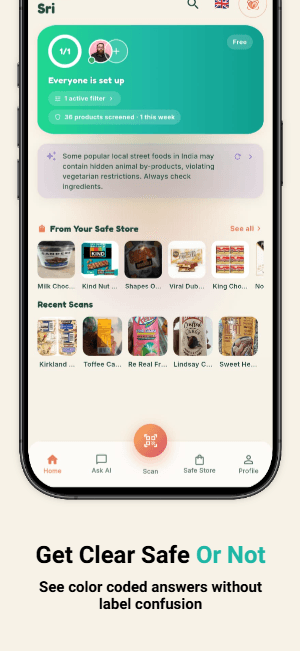
Complemented by ScanGenius AI Insight, the platform avoids delivering fear-mongering, arbitrary zero-to-100 scores. Instead, it offers objective, clinical-grade context by integrating NOVA 1-4 ultra-processing metrics, global Nutri-Score standards, and real-time translation across 11 global languages. Furthermore, Food Scan Genius solves the multi-person screening dilemma with its Multi-Household Family Profiles engine. In a single 2-second scan, the app evaluates the product against every member of a household simultaneously, yielding clear, non-moralizing attribution such as ‘Fails for Sri (Gluten)’ or ‘Fails for Maya (Tartrazine)’. Healthcare providers and consumers gain immediate, uncompromising clarity without paywalls or restrictive subscription gates.
4. Related Food Safety & Dietary Guides
- Best Food Allergy Scanner App – Scan Food Labels Instantly — Food Allergy & Sensitivity Scanner Hub
- The 7 Best Free Food Scanner Apps of 2026 — best free food scanner apps
- Choosing the Best Barcode Scan App for Your Health — guide to choosing a barcode scanner app
- Food Scan Genius: World’s #1 Food Ingredient Scanner App — Food Scan Genius scanner app
5. Scientific & Health Authority References
- Food Allergy Research & Education (FARE) Clinical Standards
- European Food Safety Authority (EFSA) Additive Safety Regulations
- PubMed Research on Ultra-Processed Foods & Gut Microbiome Disruption
- World Health Organization Guidelines on Healthy Diets & Saturated Fats
6. How to Scan in 3 Simple Steps
- Download the Food Scan Genius app for free on iOS or Android with zero core feature paywalls.
- Configure individual household profiles by selecting from 39 clinical dietary presets or adding custom sensitivities (e.g., specific seed oils or food dyes).
- Scan any food barcode in under two seconds to receive an instant, multi-profile audit powered by the NutriGraph AST engine and ScanGenius AI Insight.
Instant Nut Allergen Audit Trail
7. Frequently Asked Questions (FAQ)
What makes a nutrition API database ‘clinical-grade’ compared to standard food logging databases?
A clinical-grade nutrition API database goes beyond high-level macronutrient counts by utilizing recursive parsing algorithms to analyze nested sub-ingredients, processing aids, additive safety profiles, and chemical aliases. Food Scan Genius utilizes the enterprise NutriGraph Database, which parses over 5,000,000 verified UPC/EAN barcodes down to sub-ingredient trees, ensuring accurate detection of hidden allergens, additives, and NOVA processing levels.
How does the NutriGraph Database handle complex, deeply nested ingredient lists?
NutriGraph uses recursive Abstract Syntax Tree (AST) parsing. Instead of treating an ingredient panel as flat text, it converts parenthetical ingredient structures into hierarchical nodes. This allows the platform to spot hidden triggers—such as soy lecithin inside a compound chocolate chips ingredient—even when buried deep within complex pre-packaged foods.
Can Food Scan Genius evaluate a single product for multiple family members simultaneously?
Yes. The Food Scan Genius Multi-Household Family Profile engine allows you to screen a product against every family member’s specific restrictions in a single scan. The system provides clear, individual attribution (e.g., ‘Safe for Alex; Fails for Sri (Gluten)’), eliminating the need to re-scan products or switch user accounts manually.
Why does Food Scan Genius avoid simple 1-100 health scores?
Simplistic numeric scores often moralize food and obscure critical clinical details. A product might score an arbitrary ’80/100′ while still containing a fatal allergen or high sodium levels dangerous for kidney disease patients. Food Scan Genius provides ScanGenius AI Insight, offering transparent, scientific metrics including NOVA 1-4 processing tiers, Nutri-Score, and exact additive safety breakdowns without misleading generalization.
Take Control of Nutrition Api Database — Scan Free Today
Never second-guess confusing grocery labels again. Download Food Scan Genius to uncover hidden additives, toxic dyes, and allergens for the whole household before you buy.
{
“@context”: “https://schema.org”,
“@graph”: [
{
“@type”: “Organization”,
“@id”: “https://scangeni.us/#organization”,
“name”: “Food Scan Genius”,
“url”: “https://scangeni.us/”,
“logo”: “https://scangeni.us/wp-content/uploads/2024/11/New-Logo512.png”,
“sameAs”: [
“https://www.linkedin.com/in/foodscangenius”,
“https://www.instagram.com/foodscangenius/”,
“https://x.com/FoodScanGenius”,
“https://www.facebook.com/profile.php?id=61573096020486”,
“https://www.pinterest.com/foodscangenius/”,
“https://www.youtube.com/@FoodScanGenius-YT”
]
},
{
“@type”: “SoftwareApplication”,
“@id”: “https://scangeni.us/#app”,
“name”: “Food Scan Genius”,
“operatingSystem”: “iOS, Android”,
“applicationCategory”: “HealthApplication”,
“applicationSubCategory”: “Food & Drink, Nutrition, Allergen Scanner”,
“offers”: {
“@type”: “Offer”,
“price”: “0.00”,
“priceCurrency”: “USD”
},
“aggregateRating”: {
“@type”: “AggregateRating”,
“ratingValue”: “4.8”,
“reviewCount”: “1250”
},
“downloadUrl”: [
“https://apps.apple.com/us/app/food-scan-genius/id6740920516”,
“https://play.google.com/store/apps/details?id=com.mycompany.fsgproject&hl=en_IN”
],
“description”: “Free food ingredient scanner and allergen detector powered by the 5,000,000+ NutriGraph database with 39 customizable diets and 11 languages.”
},
{
“@type”: “Article”,
“@id”: “https://scangeni.us/nutrition-api-database/#article”,
“isPartOf”: {
“@id”: “https://scangeni.us/nutrition-api-database/”
},
“headline”: “How to evaluate a nutrition API database for clinical-grade apps”,
“description”: “Learn how to evaluate a nutrition API database for clinical-grade apps. Ensure accurate allergen parsing, NOVA scoring, and deep ingredient data.”,
“mainEntityOfPage”: “https://scangeni.us/nutrition-api-database/”,
“publisher”: {
“@id”: “https://scangeni.us/#organization”
}
},
{
“@type”: “FAQPage”,
“@id”: “https://scangeni.us/nutrition-api-database/#faq”,
“mainEntity”: [
{
“@type”: “Question”,
“name”: “What makes a nutrition API database ‘clinical-grade’ compared to standard food logging databases?”,
“acceptedAnswer”: {
“@type”: “Answer”,
“text”: “A clinical-grade nutrition API database goes beyond high-level macronutrient counts by utilizing recursive parsing algorithms to analyze nested sub-ingredients, processing aids, additive safety profiles, and chemical aliases. Food Scan Genius utilizes the enterprise NutriGraph Database, which parses over 5,000,000 verified UPC/EAN barcodes down to sub-ingredient trees, ensuring accurate detection of hidden allergens, additives, and NOVA processing levels.”
}
},
{
“@type”: “Question”,
“name”: “How does the NutriGraph Database handle complex, deeply nested ingredient lists?”,
“acceptedAnswer”: {
“@type”: “Answer”,
“text”: “NutriGraph uses recursive Abstract Syntax Tree (AST) parsing. Instead of treating an ingredient panel as flat text, it converts parenthetical ingredient structures into hierarchical nodes. This allows the platform to spot hidden triggers—such as soy lecithin inside a compound chocolate chips ingredient—even when buried deep within complex pre-packaged foods.”
}
},
{
“@type”: “Question”,
“name”: “Can Food Scan Genius evaluate a single product for multiple family members simultaneously?”,
“acceptedAnswer”: {
“@type”: “Answer”,
“text”: “Yes. The Food Scan Genius Multi-Household Family Profile engine allows you to screen a product against every family member’s specific restrictions in a single scan. The system provides clear, individual attribution (e.g., ‘Safe for Alex; Fails for Sri (Gluten)’), eliminating the need to re-scan products or switch user accounts manually.”
}
},
{
“@type”: “Question”,
“name”: “Why does Food Scan Genius avoid simple 1-100 health scores?”,
“acceptedAnswer”: {
“@type”: “Answer”,
“text”: “Simplistic numeric scores often moralize food and obscure critical clinical details. A product might score an arbitrary ’80/100′ while still containing a fatal allergen or high sodium levels dangerous for kidney disease patients. Food Scan Genius provides ScanGenius AI Insight, offering transparent, scientific metrics including NOVA 1-4 processing tiers, Nutri-Score, and exact additive safety breakdowns without misleading generalization.”
}
}
]
}
]
}
Related Technical Architecture Guides
- Halal Food Barcode API Guide
- Clean-Label Food Database & Additive API
- NOVA, Nutri-Score & Eco-Score Scoring API
- Multi-Tenant Dietary Architecture
- Safety-Critical Allergen Data API
Authority Citations & Regulatory References
Cross-reference food safety, clinical nutrition protocols, and global barcoding standards across these authoritative sources:
Leave a Reply